
Improve Your Brain with Physical Activities

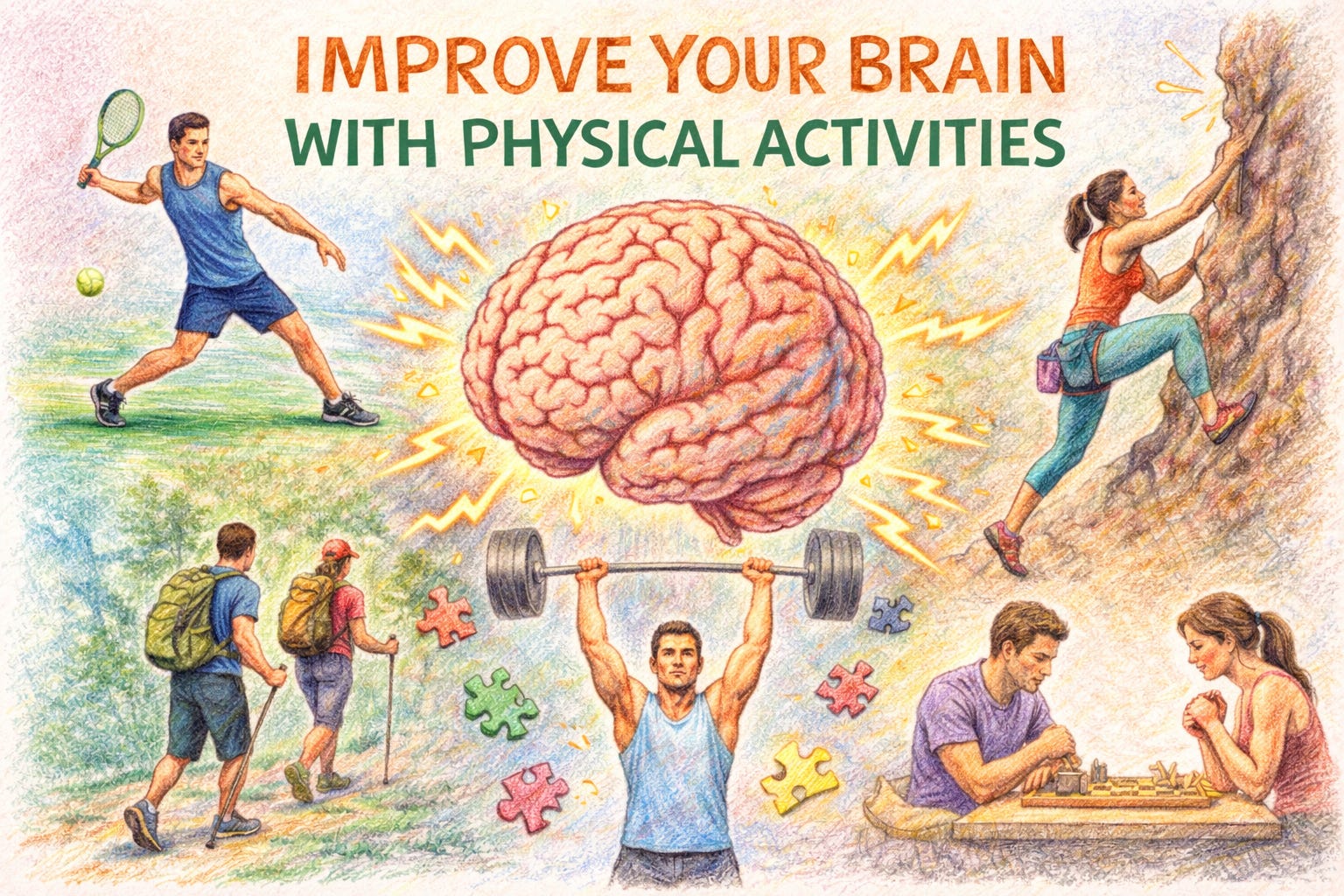
When people say “exercise your brain,” most of us think of puzzles, brain games, or learning something new. Those things absolutely help. But they’re not the only way, and they might not even be the most complete way, to challenge your brain.
Your brain isn’t just built to think. It’s built to move, solve problems, and adapt at the same time.
Your Brain Was Built for Movement
There’s a growing body of research in neuroscience and exercise science showing that physical activity directly improves brain health.
Regular movement has been shown to:
Improve memory and learning
Increase attention and focus
Support executive function (decision-making, problem-solving)
Promote neuroplasticity (your brain’s ability to adapt and change)
One of the key drivers behind this is a protein called BDNF (brain-derived neurotrophic factor), which increases with physical activity and supports the growth and survival of neurons.
In simple terms:
Movement doesn’t just train your body. It trains your brain.
But Not All Movement Challenges Your Brain the Same Way
Walking, lifting, running… these all have benefits. But there’s another layer that often gets overlooked:
How much does the activity require you to think, react, and solve problems?
This is where the power lies.
When you combine physical effort with decision-making, timing, coordination, and unpredictability, you’re no longer just exercising your body. You’re training the connection between your brain and your body.
Your brain and body are integrated and bidirectional. Meaning your brain generates thoughts that require physical action, and it also responds to stimuli from the environment that your body is interacting with.
Where Cognitive and Physical Demands Meet
Think about activities like:
Sports
Pick-up games
Agility drills
Hiking technical terrain
Martial arts
Skill-based lifting or movement
Even certain physical hobbies or trades
In these situations, you’re not just moving. You’re:
Reading the environment
Making decisions
Adjusting in real time
Coordinating your body to match your intent
You might be able to solve the “problem” in your head, but executing it physically is a different challenge entirely.
That’s the point I’m getting to!
Because now you’re dealing with constraints:
Your strength
Your coordination
Your endurance
Your timing
Your awareness
You’re forced to understand your physical capabilities and decide how you’re going to solve the problem based on those capabilities. And when you add efficiency to the equation, you really have to understand yourself and what you’re capable of.
This Is a Different Kind of “Brain Training”
A puzzle on your phone challenges your brain in isolation.
A physical task that requires thinking challenges your brain in context.
It forces your brain to:
Process information
Make decisions
Execute through your body
Adjust based on feedback
That loop is powerful, and it’s much closer to how your brain actually operates in real life.
What This Means for You
If your goal is overall health and well-being, to remain independent and functional, to hold onto your memories, and to make good decisions, don’t separate “brain exercises” from your physical training.
Add more activities that require you to:
Think while you move
React instead of repeat
Solve problems in real time
Coordinate your body under changing conditions
That could be:
Playing a sport (basketball, tennis, soccer)
Joining a rec league (pickleball, dodgeball, paddle tennis)
Learning a new physical skill (gymnastics, rock climbing)
Doing more dynamic, variable training (athletic training, TGFU, hiring a coach)
Getting outside and navigating unpredictable environments (camping, hiking)
Starting a trade or physical hobby (woodworking, sewing, gardening)
Volunteering (search and rescue, environmental organizations, youth programs)
Final Thought
Your brain isn’t separate from your body.
It’s part of the same system.
And one of the most effective ways to challenge it is not just to think harder, but to move, solve, and adapt at the same time.