
Everything Revolves Around Sleep
Why the variable you keep deprioritizing is the one that controls every other outcome you care about

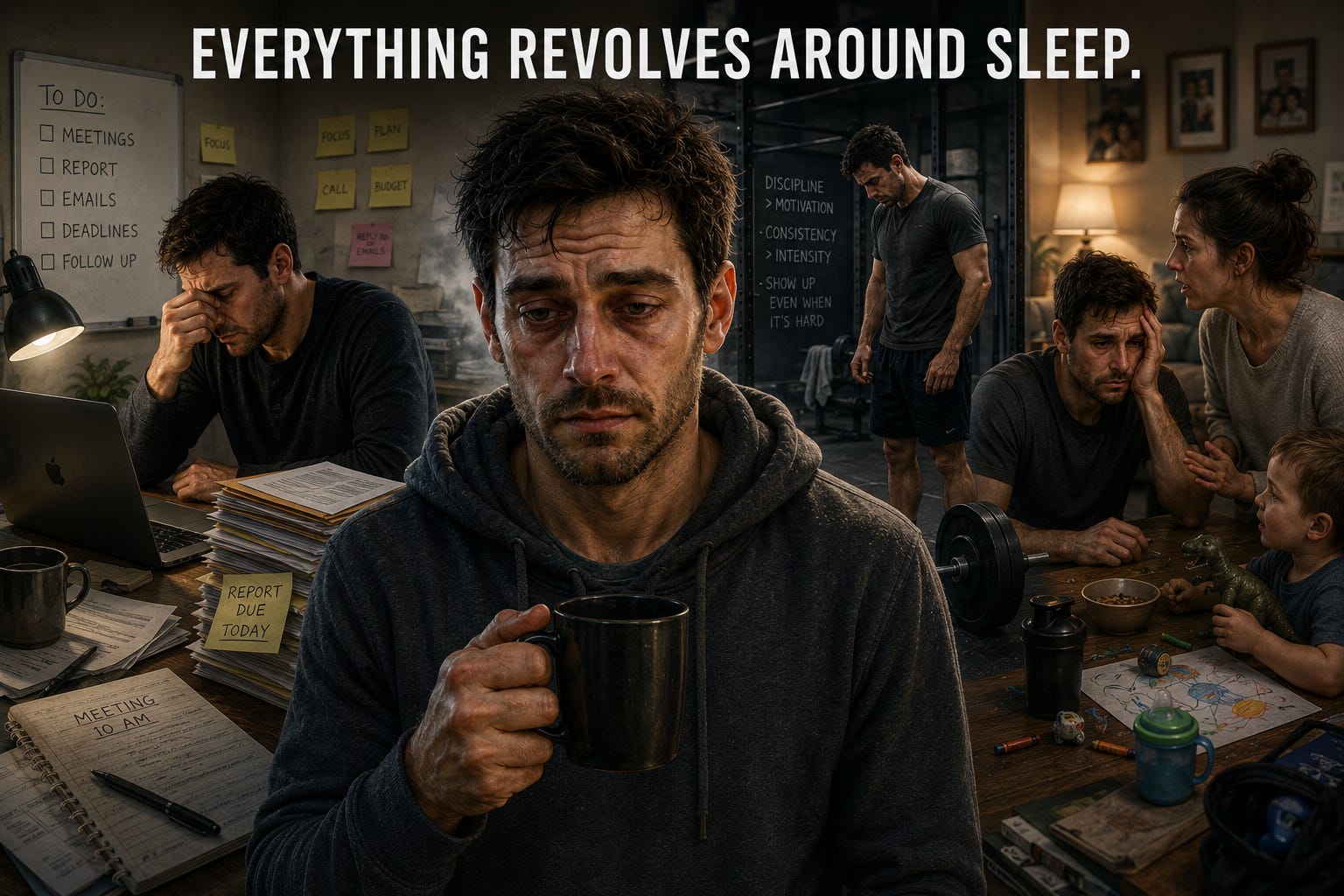
Most people approach their health as a series of separate problems. Energy is one problem. Stress is another. Weight is its own thing. Mood, focus, motivation, recovery, performance; each gets its own intervention, its own protocol, its own attempt at a fix.
This is a convenient framework, but it’s wrong.
These aren’t separate problems. They are connected systems, and they all sit downstream of one variable that determines whether any other intervention you try actually works. That variable is sleep.
I’ve been coaching people long enough to be confident in saying this plainly: if you’re trying to improve something in your life, anything, and sleep is not in good shape, you are working at a fundamental disadvantage. You can train harder, eat cleaner, meditate, journal, optimize your schedule, and chase every other wellness trend on the internet, and you will still hit a ceiling defined by what your sleep is or isn’t doing for you.
This article is about why that’s true, what the science actually shows, and what to focus on.
What Sleep Is Actually Doing
For most of modern history, sleep was understood as the absence of activity, the time when nothing was happening. We now know the opposite is true. Sleep is when your body and brain do their most important work, and the scope of that work is staggering.
Your brain is being cleaned. During deep sleep, your brain activates the glymphatic system, a biological waste removal process. Cerebrospinal fluid flushes through brain tissue and clears out toxic metabolic byproducts, including beta-amyloid and tau proteins, the same proteins associated with Alzheimer’s disease. Research on successful cognitive aging has found thicker anterior and mid-cingulate cortex tissue and lower tau deposition compared to typical aging. The brain that ages well is the brain that has been consistently cleaned out.
Memory is being consolidated. Everything you learned, experienced, and processed during the day is being filed, organized, and stored during sleep. Sleep deprivation has been found to impair various types of long-term memory formation and decrease retrieval performance. If you sleep poorly, you literally remember less of what’s happening in your life.
Your hormones are being calibrated. Roughly 70-80% of daily human growth hormone is secreted during slow-wave sleep, driving muscle repair, tissue remodeling, and recovery. Testosterone production requires at least three hours of uninterrupted sleep, meaning that even if total hours look adequate on paper, interrupted sleep can suppress it. Chronic sleep deprivation also alters glucose metabolism and insulin sensitivity, increasing the risk of obesity and type 2 diabetes. Leptin and ghrelin, your fullness and hunger hormones, get scrambled, with leptin dropping and ghrelin rising. This is not a willpower problem when your sleep is broken. It is a hormonal one.
Your immune system is being maintained. A single night of 24-hour sleep deprivation in young, lean, healthy individuals altered the profile of immune cells to resemble that of individuals with obesity, a condition known to drive chronic inflammation. If these shifts persist, they could contribute to long-term inflammatory states and increase the risk of disease. One night of chronic sleep deprivation creates a low-grade inflammation that substantially contributes to the onset and exacerbation of metabolic and neurodegenerative disorders.
Your cardiovascular defense system. A 2011 systematic review found that short sleep duration was associated with a 45% increased risk of coronary heart disease. A separate meta-analysis found that the risk of cardiovascular disease was 16% higher for those with nonrestful sleep, 22% higher for those with difficulty initiating sleep, and 14% higher for those with difficulty maintaining sleep. Sleep duration appears to follow a U-shaped curve, both too little and too much are associated with higher mortality, with the sweet spot landing at seven to nine hours for most adults.
Your emotional regulation is being restored. Sleep deprivation disrupts the balance between the amygdala, the brain’s emotional reactivity center, and the prefrontal cortex, which is responsible for regulating those reactions. The amygdala becomes hyperactive while the prefrontal cortex shows reduced activity. The result is an amplified emotional response coupled with reduced capacity for emotional control. Translation: when you’re underslept, you feel more, react bigger, and have less ability to manage either.
This is what’s happening, every night, in every system simultaneously. Sleep isn’t doing one thing well. It’s doing dozens of things well, all at once.
The Downstream Cascade
Now here’s where it gets interesting, and where the “everything revolves around sleep” theory stops sounding like an opinion and starts sounding very real.
When the biology above is functioning properly, you experience it as stable energy, sharp focus, level mood, healthy appetite, motivation to train, the willpower to make good decisions, patience with the people around you, and the capacity to perform at work. These are not separate gifts. They are outputs of the same upstream system working correctly.
When sleep breaks, all of those outputs degrade simultaneously. And then they start interacting with each other.
You wake up tired, so you reach for more caffeine. The caffeine helps you function but disrupts tonight’s sleep, deepening the deficit. Your hunger hormones are dysregulated, so the snacks you would have normally resisted become much harder to resist. Your willpower is operating at reduced capacity in the exact moment you need more of it. You eat worse, which affects your energy and recovery further. You feel less motivated to train. You skip the workout, or you train, but the quality is poor and the recovery from it is incomplete because your hormonal environment isn’t supporting adaptation.
Your emotional regulation is compromised, so the small frustrations at work feel bigger, the conversation with your spouse goes sideways more easily, and the patience with your kids runs thin. You bring less to your relationships. You handle stress worse. Chronic sleep deprivation exacerbates stress and anxiety levels over time.
Your cognitive function is impaired in ways you often can’t perceive in yourself. You make worse decisions throughout the day. The plan you made for the week starts to fall apart because the version of you executing it doesn’t have the same resources the version of you who planned it had.
This is the snowball. Each system failure feeds the next one. None of these are character flaws. They are the predictable downstream consequences of an upstream problem. And the worse part, the more you grind through this, the more the feeling of chronic sleep becomes normalized. You essentially calibrate to it and think everything is as optimal as it should be.
The opposite is also true, and this is the part worth holding onto. When sleep is consistently good, the same compounding works in your favor. Energy supports better food choices. Better food choices support better training. Better training supports better recovery. Stable mood supports better relationships. Sharp cognition supports better work. Each system reinforces the next. Sleep doesn’t remove a brake, it provides maintenance and fuel for everything else to function.
A Note on Those Who Can’t Fully Control This
Some people reading this work jobs that disrupt sleep no matter what they do — firefighters, nurses, ER physicians, military personnel, parents of infants, and anyone else whose schedule isn’t fully their own. Acknowledging this matters because it would be dishonest to suggest the principles in this article apply equally to everyone.
If you’re in this category, the goal shifts. You’re not maximizing, you’re managing. The strategies still apply, but the targets are realistic ones for your reality, not idealized ones for someone with full control of their schedule. What you can control becomes more important precisely because you can’t control everything. That’s a longer conversation that deserves more space than this article allows, but the foundational principles below still apply within whatever constraints your life imposes.
Where Sleep Is Usually Breaking Down
If sleep is this important, the natural next question is what to actually do about it. That answer is less universal than the wellness industry pretends. The research points to a relatively small set of categories that consistently matter most, but how those categories apply to your specific life, your schedule, your profession, your training demands, your family situation, your existing habits, is where the actual work happens.
The major categories are worth knowing, even if the specific application requires more than this article can offer.
Consistency. Your circadian rhythm is anchored more strongly to your wake time than your sleep time, and inconsistency across the week disrupts every downstream system mentioned above. Most people significantly underestimate how much this matters and how much weekend variability costs them.
Light exposure. Morning light and evening light operate as biological signals, telling your brain when to be awake, when to start preparing for sleep, and when to release melatonin. Most modern lifestyles get these signals bass-ackwards.
Caffeine and stimulant timing. Caffeine’s half-life is longer than most people realize, and the relationship between caffeine intake and sleep disruption is rarely as straightforward as “I can fall asleep fine after coffee.” Falling asleep and sleeping well are not the same thing.
Sleep environment. Temperature, light, and noise control are all variables that either cooperate with your physiology or fight it. Most bedroom environments are fighting it.
The pre-sleep window. What happens in the 60 to 90 minutes before bed determines whether your body is biologically prepared to sleep when you lie down. This includes training timing, screen exposure, food and alcohol intake, thoughts, and stress regulation. The right approach for each varies significantly between people.
Continuity protection. Sleep duration gets most of the attention, but the research suggests that interrupted sleep is significantly more disruptive than slightly shorter unbroken sleep. A Johns Hopkins study found that those who were forced to awaken experienced a reduction of 31 percent in positive mood, while a group with a delayed bedtime, receiving the same shortened total, declined only 12 percent. Protecting against awakening matters as much as protecting total hours.
These are the categories. The applications inside each one are highly individual, and getting them right is rarely as simple as reading a list and executing it.
The Bigger Point
Most people, when they decide to take their health seriously, start with what’s most visible, training and nutrition, primarily. These are legitimate places to put effort. But if sleep isn’t in order first, you are putting effort into systems that won’t fully respond. The training adaptations won’t fully consolidate. The nutritional discipline won’t be sustainable. The motivation to maintain either won’t be reliable.
If you are trying to improve something in your life and you are not also working on your sleep, you are starting with a leak in the foundation and trying to renovate the upstairs.
Start downstairs. Fix the foundation. Then everything else you do on top of it will hold.
That’s why everything revolves around sleep. Not because it’s the most important thing in isolation, but because it’s the variable that determines whether everything else you care about is actually possible.
Working on sleep with my coaching clients is one of the most consistently high-return parts of what I do, not because sleep is complicated, but because the right adjustments for one person are rarely the right adjustments for another, and getting it wrong wastes months of effort on the wrong levers. The clients I work with also receive an exclusive weekly newsletter that goes deeper into questions like these, with specific protocols and applications they can actually implement.
If you’ve read this and recognized that sleep is one of the things quietly limiting what you’re trying to build in your life, that’s worth a conversation.
— Coach Keef | Culture Athletics